Abacus Classes
Why is Abacus Learning is important for children?
While it’s easy for a small percentage of lucky children, most children find numbers and math very difficult! Abacus learning is one of the best ways to improve arithmetic skills and number fluency. Abacus math also helps develop an interest and passion in math for many students as their confidence and understanding grows from an early age. After all, most students prefer the subjects they perform well in!
Introduced in China, Abacus Learning has made it easy to calculate basic arithmetic operations like subtraction, addition, division, and multiplication. It’s an enhancement tool for mental operations as it helps in learning math operations from the very basic to the quite complex.
How does Abacus learning help the students?
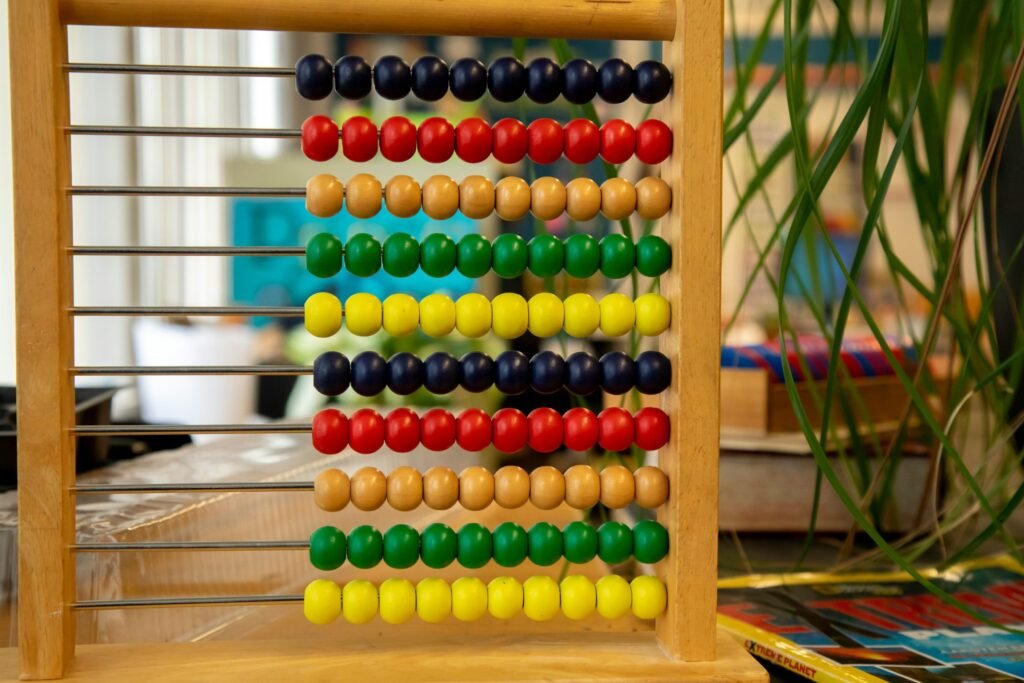
Counting numbers with fingers and hands was the method used before the application of sticks and stones. Later beads – ‘The abacus’ – was invented and it is the most creative way to count numbers easily and quickly. Many countries across the world used the abacus to teach basic calculations. As an advanced form of learning math, many schools, especially in Asia, use abacus in both primary and secondary classes. It’s been proven as one of the most effective methods for young learners to do mental math.
Abacus learning not only helps with the basic calculations like addition, multiplication, subtraction, and division, it also helps in effective counting of decimal points, negative numbers, etc.
Importance of Abacus training?
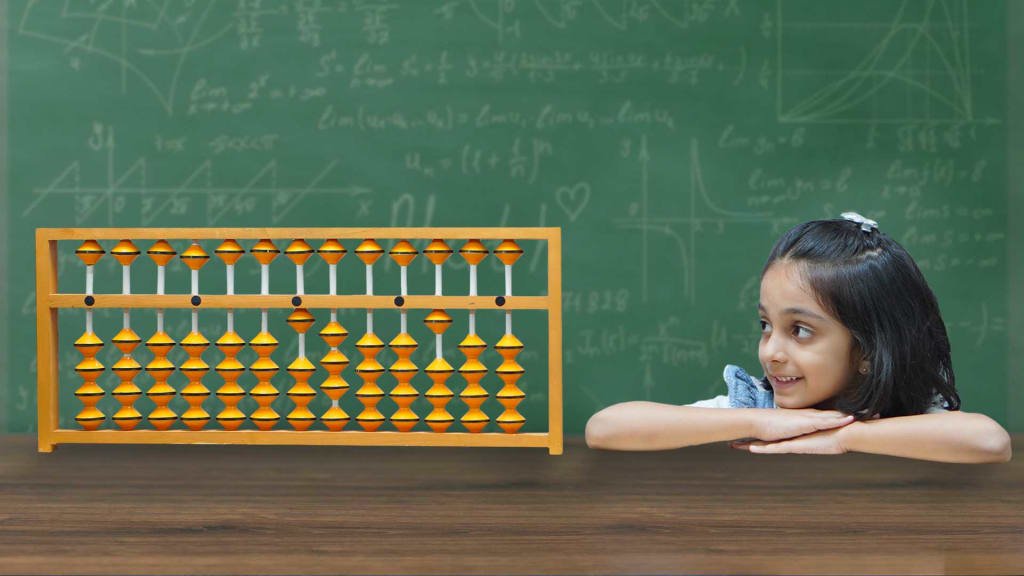
When students learn to use an abacus, they use their hands and a tool with beads to calculate numbers. It is believed that the movement using fingers gives them an opportunity to activate the brain sensors. The activity in the right hand helps them to coordinate and the left side of the brain and vice versa. This brings several benefits to the brain.
Here are some of the key benefits of abacus learning.
- With Abacus, calculation skills are boosted, and students can complete calculations faster and more accurately
• Abacus promotes a stress-free way of learning math concepts which build confidence
• It enhances problem-solving abilities
• Abacus learningnot only focuses on getting the correct answer but also helps with logical reasoning
• Abacus programs not only teach math but also help in improving concentration levels
• It boosts self-confidence and self-esteem
• It strengthens mental skills like visualization and memory
• It helps with improvised writing and reading by promoting memory and creativity.
Age group
- 5 years to 14 years is the right age for joining Abacus
There are 9 levels in Abacus
Runners Level – I (1st to 4th Standard).
- Big B Formulae +9 to +1
- Big B Formulae -9 to -1 Add/Less With Abacus – 1/2 Digit sums
Runners Level – II (1st to 4th Standard)
- Small Sis Formulae +4 to +1
- Small Sis Formulae -4 to -1
- Combination Formulae +9 to +6
- Combination Formulae -9 to -6
- Add/Less with Abacus – 1/2 Digit sums
Sprinters Level – I (5th Standard Onwards)
- Big B Formulae +9 to +1
- Big B Formulae -9 to -1
- Small Sis Formulae +4 to +1
- Small Sis Formulae -4 to -1
- Combination Formulae +9 to +6
- Combination Formulae -9 to -6
- Add/Less with Abacus – 1/2 Digit sums
Runners Level III /Sprinters Level II
- Without Abacus – Add/Less 1/2Digit
- With Abacus – Add/Less 2Digit
- Continuous Add/Less 1 to 10
- Multiplication – With Abacus 2Digit x 1Digit
Runners Level IV/Sprinters Level III
- Without Abacus – Add/Less 1/2Digit
- With Abacus – Add/Less 2D/3Digit
- Continuous Add/Less 11 to 20
- Multiplication – With Abacus 3Digit x 1Digit
- Division – With Abacus 2Digit / 1Digit
- Multiplication – Without Abacus 2D x 1D
Runners Level V/Sprinters Level IV
- Without Abacus – Add/Less 1/2D
- With Abacus – Add/Less 3D
- Continuous Add/Less 21 to 30
- Multiplication – With Abacus 2D x 2D and 3D x 2D
- Division – With Abacus 4D / 1D
- Multiplication – Without Abacus 3D x 1D
Advance level 1
- 1) 3-digit cumulative addition and subtraction (finger exercise)
- 2) 4digit addition and subtraction (4 times in 1 problem) 20sums
- 3) 4-digit Continuous addition and subtraction with abacus [ 10 times]
- 4) 2digit without abacus (+ & -)
- 5) 2digit * 2digit multiplications [ without abacus]
- 6) 4digit / 1digit division (with abacus)
- 7) Orals [ with/without abacus] 2digits
- 8) Decimal sums 1digits
- 9) 1digit negative sums
- 10) model papers
Advance level 2
- 3-digit cumulative addition and subtraction (finger exercise)
- 4digit / 2digit division (with)
- 4digit addition and subtraction (6 times in 1 problem) 20sums
- 4-digit Continuous addition and subtraction with abacus [ 10 times]
- 2digit * 2digit multiplications [ without abacus]
- 3digits / 3digits multiplications (with abacus)
- Orals [ with/without abacus] 2digits (12times)
- 2digit negative sums
- Decimal sums 2 digits
- model papers
Grand level 1
- 5 digits cumulative addition and subtraction (15times in 1 problem)
- 5digit addition and subtraction (4 times in 1 problem) 20sums
- Orals [ with/without abacus] up to 3digits
- 3digit * 3digit multiplications [ with abacus]
- 3digit * 2digit multiplications [ without abacus]
- 4digit / 2digit division (with abacus)
- 3digits negative sums
- 5-digit Continuous addition and subtraction with abacus [ 15 times]
- Decimal sums 3 & 4 digits [ with abacus]
- model papers
Grand level 2
- 5-digit cumulative addition and subtraction (15 times in 1 problem)
- Addition and subtraction up to 5 digits (up to 5 times in 1 problem)
- 4digit addition and subtraction (times in 1 problem) 20sums
- 5-digit Continuous addition and subtraction with abacus [ 15 times]
- 4digit * 4digit multiplications [ with abacus]
- Orals [ with/without abacus] 4 & 5 digits. {up to 15 times}
- 3digit negative sums
- 4digit / 2digit division (without abacus)
- 5digit / 3digit division (with abacus)
Education Programs
Activities Involved
- Sensory Time
- Free Play with Technology Corner
- Puppet shows and skits
- Sensory Time
- Free Play with Technology Corner
- Puppet shows and skits
Mon-Fri
Age
Class Size
5:00 PM - 7:00 PM
5-14 Years
60 Min
Our Contacts

Call
+91 9898147941

Address
Franklin St, Greenpoint Ave
Other Classes
Common Questions About Sharp Minds Academy
Our team helps parents select the most suitable class based on the child’s age, learning level, and goals. You can also request guidance before enrollment.
Each class has a different duration depending on the skill and learning level. Program details, batch timings, and schedules are shared during registration.
Yes. All our classes start from basic to advanced levels, making them suitable for beginners as well as students with prior knowledge.
We conduct regular practice sessions, worksheets, activities, and progress reviews to track improvement and ensure consistent learning.
Yes. Children can enroll in multiple classes based on their interest and schedule. We help plan a balanced learning routine.
Classes are primarily conducted offline for better interaction. Availability of online classes may vary depending on the program.